This is the first post in my Daily DSA series.
The Queue
The queue is one of the most basic data structures. As one could guess from the name it’s like a queue. You enqueue some elements at the end and then dequeue them at the beginning.
It is what’s called FIFO (First In First Out). That means that the first element we put into it is the first which we get out again. Which makes sense with a queue. If you are the last to arrive at the checkout in the supermarket you’re also the last one who gets to pay.
Anatomy of a Queue
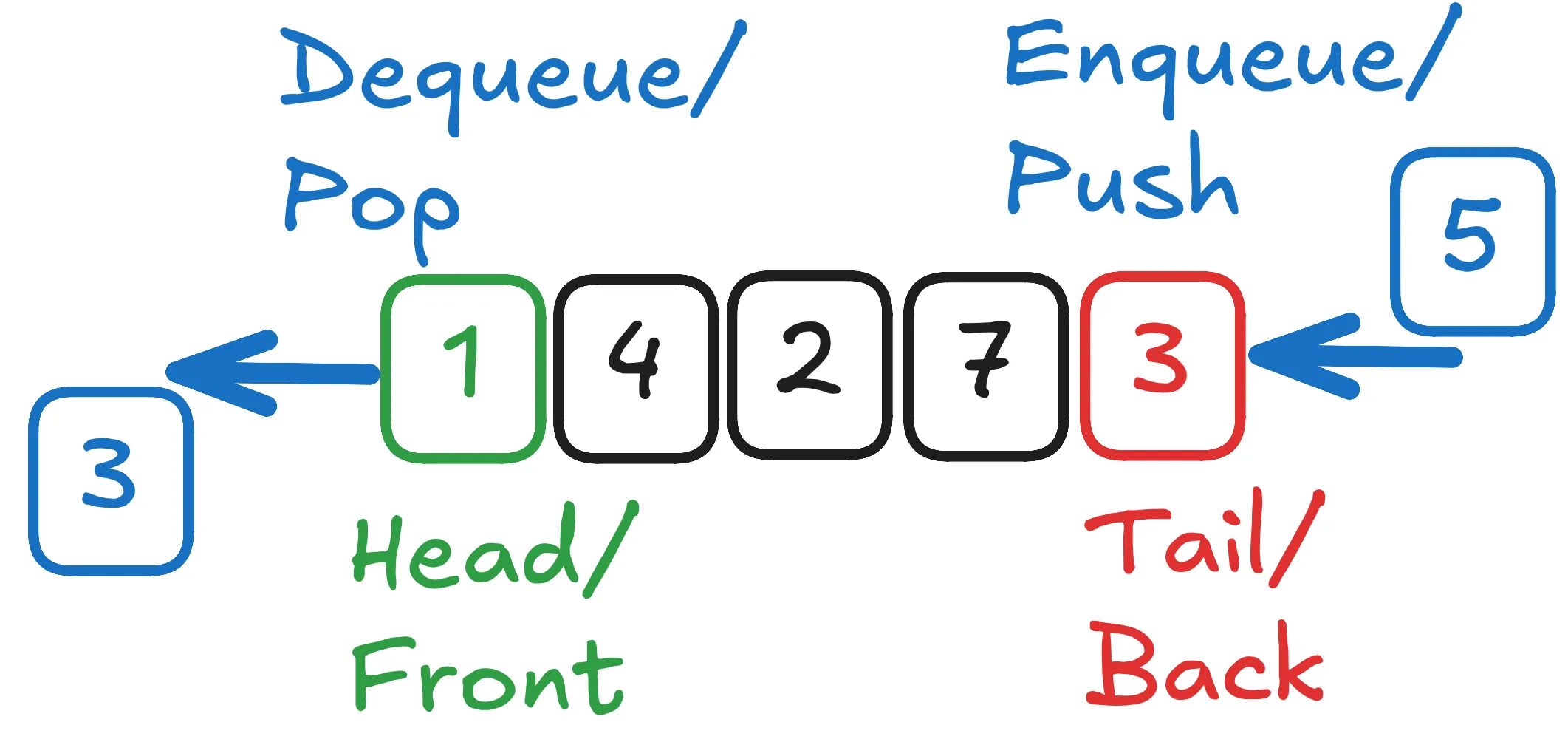
A queue can consist of elements of any type. Here we just have simple integers as keys. The first element in the queue (the next one to be dequeued) is generally called head or front. The last one tail or back.
Operations
The two most important operations for a queue are enqueue and dequeue.
Enqueue adds a new element to the back of the queue and dequeue removes the
first element of the queue and returns it. Sometimes (at least I do so) they’re
also called push and pop. 1
Other useful functions a queue could provide are is_empty (obvious) and peek
(look at first element without removing it.
Some useful attributes some implementations provide is a size (how many
elements there currently are) and capacity (how many elements there at most
can be). If you don’t think that the user can do it himself, you can with these
provide another helper function is_full.
Analysis
I promise for some later stuff this will be interesting.
The analysis for this is really straightforward. Space is , all operations
should be (if you didn’t either do a really weird implementation or doing
weird operations like search).
Implementation
A simple implementation of a queue can be done using a doubly linked list. The
normal way to do this in Rust (and also a quite efficient and more cache
friendly way) is to use the std::collections::VecDeque. This is a double ended
queue 2. So it has similar properties as the queue described above, put allow
push and pop from both ends. So if you want exactly what was described
above, just use push_back and pop_front. But you can also use both ends of
the queue if it fits your use case.
use std::collections::VecDeque;

let mut deq = VecDeque::from([-1, 0, 1]);

let first_element = deq.pop_front(); // Some(-1)

deq.push_back();
For more (mostly) useful methods see the std docs.
Manual Implementation with Array
For educational purposes we’ll implement a queue ourselves. It uses an array (ewww, lifetimes needed) to implement a ring buffer which is used to implement the queue. It therefore has a fixed capacity and insert can fail.
I wouldn’t recommend actually using this and the only thing I can guarantee about it is, that it’s not written by an LLM.
pub struct Queue<'a> {
    buffer: &'a mut [i32],
    len: usize,
    head: usize,
    tail: usize,
}

impl<'a> Queue<'a> {
    /// Create a new queue using an existing buffer
    pub fn new(buffer: &'a mut [i32]) -> Self {
        Self {
            buffer,
            head: 0,
            tail: 0,
            len: 0,
        }
    }

    /// Enqueue an item
    /// Returns true on succes, false on error
    pub fn enqueue(&mut self, item: i32) -> bool {
        let capacity = self.buffer.len();
        if self.len == capacity {
            return false;
        }
        self.buffer[self.tail] = item;
        // Wrap around
        self.tail = (self.tail + 1) % capacity;
        self.len += 1;
        true
    }

    pub fn dequeue(&mut self) -> Option<i32> {
        if self.len == 0 {
            return None;
        }
        let item = self.buffer[self.head];
        self.head = (self.head + 1) % self.buffer.len();
        self.len -= 1;
        Some(item)
    }
}
You could improve this by
- Making it for a generic type
T - Using a
Vec<T>for storage to allow dynamic capacity (if that’s wanted)
Use Cases
Queues have some real world applications and also a lot of them in other algorithms (of which I’ll hopefully cover plenty here later).
One of the most obvious examples is some form of scheduling. That can be e.g. a server having to do multiple tasks and then there are workers which can take tasks from the queue and work on them. This can trivially be implemented with a queue. It also works quite well with multiple workers and schedulers with a simple lock while pushing/popping.
Non-Use Cases
- Things which need deletion/insertion from middle
- These take time which isn’t efficient
- Examples could be if we have jobs, but some have a higher priority, so we aren’t processing strictly by insertion order
- We need to search for specific elements
- Again takes time, when faster times would be possible with more efficient data structures.
Example Problems
Throwing Cards Away
Problem: You have a deck of cards, . In each step you throw away the top card and put next card to the bottom until you just have a single card left. Which card will you have in your hand at the end?
While there might be a formula or something to calculate this in constant time (seems like an interesting problem to think about) we can solve this in by simply simulating this with a queue.
let mut q = Queue::new(cards);
while q.len() > 1 {
    queue.dequeue();
    queue.enqueue(queue.dequeue().unwrap());
}
let answer = queue.dequeue().unwrap();
”Fair” Scheduler
Problem: You got a number of jobs , each having a given duration. You have a “fair” 3 scheduler: It gives each job one another a fixed amount of time to process. Which job finishes last?
We can again easily simulate this with a queue. We just remove values from it, and readd them with reduced time if they haven’t yet finished.
struct Job {
    id: u32,
    duration: u32,
}
let mut q = Queue::new(jobs);
while q.len() > 1 {
    let mut j = queue.dequeue();
    if j.duration > t {
        j.duration -= t;
        queue.enqueue(j);
    }
}
let answer = queue.dequeue().unwrap().id;
Variations
These are some variations of the basic data structure. They’re here if you want to research more for yourself on the topic. I might also at some point write a post about them.
- Double-ended Queue (explained here)
- Priority Queue
- Monotonic Queue